
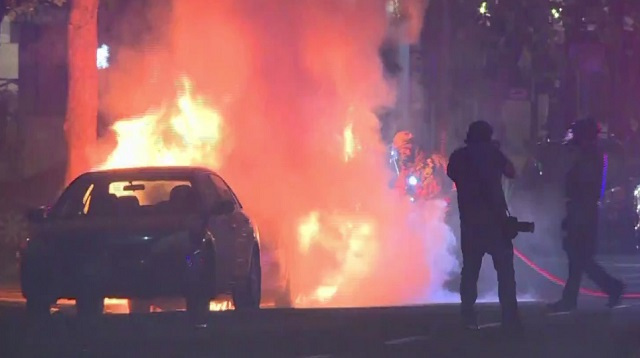



“Where are the police?”
A friend writes: “Months of riots and violence are just fine but the threat of a few thousand Proud Boys coming to Portland warrants declaring a state of emergency? https://www.reuters.com/article/us-global-race-protests-portland-idUSKBN26H0I8 “More seriously: what did the geniuses calling for defunding/abolishing police thought would happen? Granting there ARE some white supremacists—who did the geniuses thought would protect black people from their attacks? Why is suddenly local law … Continue reading “Where are the police?”


Back to the Future
I had made the mistake of giving up blogging, instead passing on links to articles with brief comments on Facebook and in some other contexts. I’ve begun to notice that those posts receive very little attention. I haven’t been blocked, but posts with a conservative political orientation seem to be downgraded. Even my own wife rarely sees them. I’ve been active in other ways, appearing … Continue reading Back to the Future
The Inquisition on Campus
Laura Kipnis, a Professor of Film Studies at Northwestern University who endured an extensive Title IX investigation at her own university for writing an article, gave the keynote address at a conference on Theorizing Consent last evening at the University of Texas at Austin. The Title IX investigations sweeping across U.S. campuses are more pervasive than most people on campus realize, and the range of … Continue reading The Inquisition on Campus
The Mysteries of Obama: A Game-Theoretic Analysis
President Obama has been on a losing streak in the international arena, claiming as victories against Russia, Iran, and Syria what any sensible observer would see as major defeats. Yet he seems to run rings around Congressional Republicans, who have approved a budget deal that funds Planned Parenthood, expanded admission of refugees, and even the Office Of Civil Rights’ assault on due process—not to mention … Continue reading The Mysteries of Obama: A Game-Theoretic Analysis
The History Wars Continue, Part VI
Today we move on to the economy and the role of government. Sparks are sure to fly. 6. “A few government and U.S. history textbooks suffer from an uncritical celebration of the free enterprise system, both by ignoring legitimate problems created by capitalism and failing to include coverage of government’s role in U.S. economic system.” (a) Here, according to the Texas Freedom Network, are the … Continue reading The History Wars Continue, Part VI
The History Wars Continue, Part V
5. “Several world geography and history textbooks suffer from an incomplete – and often inaccurate – account of religions other than Christianity.” Here, the Network is on firmer ground. Geographers and historians aren’t specialists in religion or philosophy, and they often oversimplify or make mistakes. Consider some particular complaints: (a) In describing Buddhism’s second Noble Truth, one text says, “Selfishness is the cause of suffering,” … Continue reading The History Wars Continue, Part V
The History Wars Continue, Part IV
4. “All of the world geography textbooks inaccurately downplay the role that conquest played in the spread of Christianity.” See what’s happening here? According to the Texas Freedom Network, textbooks aren’t allowed to say that Islam has been spread primarily through conquest, even though that’s true. They are required to say that Christianity has been spread primarily by conquest, even though that’s false. The … Continue reading The History Wars Continue, Part IV
The History Wars Continue, Part III
We’ve been seeing a pattern: the Texas Freedom Network denounces textbooks, not for saying things that are false, but for declining to give their preferred narrative. They attack books for giving arguments on the other side of their own political positions. This is clear from their treatment of World History textbooks. Let’s look at their next complaint: 3. “Several world history and world geography textbooks … Continue reading The History Wars Continue, Part III
The History Wars Continue, Part II
Yesterday I talked about the Texas Freedom Network’s report on textbooks submitted to satisfy the new Texas Social Studies standards, looking at one set of complaints. Today I’ll continue by evaluating additional issues raised by the report, again as reasonable, debatable, or bogus. 2. “Two government textbooks include misleading information that undermines the Constitutional concept of the separation of church and state.” The first of these … Continue reading The History Wars Continue, Part II
The History Wars Continue, Part I
The Texas Freedom Network, a left-wing group as committed to Freedom as the former German Democratic Republic was committed to democracy, has issued a report blasting the textbooks that publishers have submitted to the Texas State Board of Education to go along with the new state guidelines, passed in 2010 after considerable controversy, which I wrote about here. Some of the complaints are justifiable, though … Continue reading The History Wars Continue, Part I
 The View from Alexandria